Home › Services
Seawall replacement and new construction
Replacement is the large project, and the decision to do it should come from an inspection rather than from a quote.
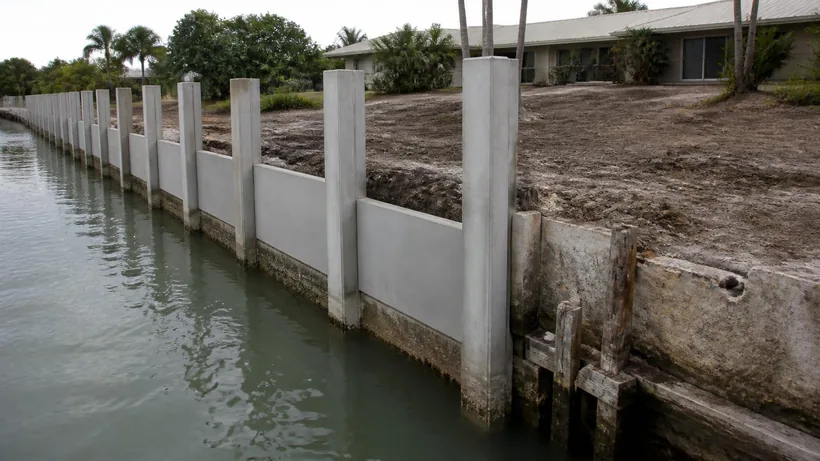
When replacement is genuinely the answer
Plenty of walls that owners assume are finished are repairable, and plenty of walls that look serviceable are not. The threshold is about the panels and the geometry rather than about appearance.
Replacement becomes the sensible answer when the panels have deteriorated through their section rather than at the surface, so there is no sound material left to restore. When reinforcement is compromised along most of the length rather than in identifiable patches. When the wall has moved far enough that it cannot be brought back into position, because a wall that is out of plumb by a significant margin is not a candidate for anchoring alone.
It is also the answer when the requirement has changed — when the retained height needs to increase, or a heavier structure is going behind the wall, and the existing system cannot carry the new demand.
And it is sometimes simply the economics. Past a certain quantity of repair, you are buying an expensive extension on something you will still replace, and the money is better spent once.
The question to ask before agreeing
If a leaning wall with reasonable panels is quoted as a replacement, ask directly whether supplemental anchoring was assessed and why it was ruled out.
There are good reasons it might be — panel condition, geometry, access, the amount of movement already taken place. But it should be a considered answer rather than a shrug, because the cost difference between restoring restraint and replacing a wall is substantial.
What replacement actually involves
- Inspection and design: establishing retained height, soil conditions, panel depth, anchoring requirements and the line the new wall will follow.
- Permitting, which takes longer than owners expect and precedes everything physical.
- Site preparation: protecting or removing what is behind the wall, establishing access, and getting equipment to a canal lot.
- Driving the new panels, which is the core structural operation and the one most affected by ground conditions.
- Installing the anchoring system — tiebacks to new deadmen or anchors behind the wall.
- Forming and pouring the new cap, tying the panels together along the top.
- Backfilling behind the wall with appropriate material, compacted properly, with drainage where the design calls for it.
- Restoring the yard, hardscape and landscaping.
The sequence matters because several of those steps are only possible before the one after it. Anchors go in before the yard is restored, for obvious reasons, and that is why replacement is disruptive to the strip of ground behind the wall in a way repairs frequently are not.
Replacing in front of, or in place of, the old wall
There are broadly two approaches and they have different implications.
A new wall built waterward of the existing one avoids demolishing the old structure and can be quicker, but it moves the wall line, which raises permitting questions and consumes water area. Whether it is available depends entirely on the regulatory position for your property.
Replacing on the existing line means dealing with the old wall — removing it or leaving it in place behind the new work — and is generally the more straightforward proposition from a permitting standpoint.
This is a decision that should be made with the permitting picture understood rather than on construction convenience alone.
Access, and why it moves the number so much
Broward canal lots are frequently narrow, heavily built and landscaped right up to the wall. Getting pile driving equipment to the back of such a property is sometimes straightforward and sometimes impossible.
Where land access works, the job runs from the yard and the cost is largely about the work itself. Where it does not, the job runs from a barge, and that brings its own economics: mobilizing a barge, working to tide and weather windows, and moving material by water.
Between two otherwise identical walls, access can be the largest single difference in what the project costs. It is the first thing a contractor looks at after the wall itself, and it is why a number over the phone is not a real number.
Where a neighbor is doing work at the same time, shared mobilization is a genuine saving and worth exploring.
Materials and how long the new wall should last
The thing that most determines the service life of a new concrete seawall in salt water is how well the concrete protects the reinforcement inside it — cover depth, mix design and workmanship.
That is unglamorous and it is the whole game. A wall built with adequate cover and a mix specified for marine exposure behaves very differently over decades from one built to a lower standard, and the difference does not show for years.
Alternative systems exist, including vinyl and composite sheet piling, and they change the corrosion picture because there is no steel in the panel to corrode. They have their own considerations — structural behavior, retained height limits, appearance, and how they tie into caps and neighboring walls — and whether they suit a given site is a design question rather than a general preference.
Whatever the panel material, the anchoring is steel and lives in the ground, and its protection matters as much as the wall face does.
What happens to the yard
Owners consistently underestimate this part, and it is worth discussing explicitly before work starts.
Installing anchors means opening a strip of ground behind the wall. Backfill has to be placed and compacted properly, which cannot be done through mature planting. Equipment needs somewhere to stand.
Good contractors plan the route in, protect what can be protected, and tell you honestly what will not survive. Ask for that conversation specifically, and ask what restoration is and is not included, because "restoration" can mean anything from replacing soil to reinstating a paver deck.
Timeline
Permitting is measured in months and precedes construction. It is the part of the schedule most owners underestimate and the part least within anyone’s control.
Construction duration depends on length, access, ground conditions and method. Barge work runs on tide and weather. Pile driving can meet conditions that slow it.
The useful posture is to start the process considerably earlier than the date you want the wall finished, particularly if the work is being done in anticipation of something — a sale, a dock project, a season.
Living through the project
Replacement is disruptive in ways that are easier to accept when they are expected.
Expect the strip behind the wall to be unusable for the duration, and expect pile driving to be audible — it is a percussive operation and it is not subtle. Expect equipment somewhere on the property, or a barge in the canal alongside.
Expect the boat to need somewhere else to be. On most projects the dock comes off or becomes inaccessible, and if a lift is involved it generally has to be removed and reinstated.
And expect weather and tide to affect the schedule if the work is barge-based, in a way they would not on a land-based job elsewhere.
None of that is a reason to defer. It is a reason to plan the timing deliberately — around the season you use the water least, ideally, rather than around when you finally got irritated enough to call.
Doing it with a neighbor
Mobilization is a genuine cost, and on a canal lot it can be a substantial share of a smaller project.
Where an adjacent owner is in a similar position, doing both walls in one mobilization is usually cheaper for both parties than doing them separately, and it resolves the return between the two walls properly rather than leaving a junction between old and new.
It is worth a conversation even if it delays your project slightly, because the saving is real and the detailing at the shared return is better.
Seawall replacement and new construction — common questions
Can I stay in the house during replacement?
Generally yes. The disruption is concentrated on the strip behind the wall and the waterfront, plus noise during pile driving, which is percussive and not subtle. The boat usually needs to be elsewhere.
What happens to my dock during the work?
On most projects it comes off or becomes inaccessible, and a lift generally has to be removed and reinstated. That is one of the strongest arguments for doing seawall work before building a new dock rather than after.
When is the best time of year to do it?
Around the season you use the water least, ideally, and with enough lead time for permitting. Deciding the timing deliberately beats starting the process at the moment the problem finally became irritating.
How do I know I need a replacement rather than a repair?
Panels deteriorated through their section, reinforcement compromised along most of the length, or a wall that has moved too far to bring back. Surface deterioration and failed anchoring on sound panels are usually repair or supplement territory. An inspection settles it.
Can the new wall go in front of the old one?
Sometimes, and it avoids demolition, but it moves the wall line and that raises permitting questions and uses water area. Whether it is available depends on the regulatory position for your property, so establish that before choosing the approach.
How much of my yard will be affected?
Installing anchors means opening a strip behind the wall, and backfill has to be placed and compacted properly. Ask specifically what will not survive and what restoration includes, because that word covers a wide range.
How long does replacement take?
Permitting takes months and comes first. Construction depends on length, access and ground conditions, and barge-based work runs on tide and weather windows. Start earlier than the date you want it finished.
Are vinyl or composite seawalls better than concrete?
They remove the steel-in-the-panel corrosion mechanism, which is the main thing that ends a concrete wall. They have their own structural and design considerations and are not automatically right for every site or retained height. It is a design question.
Will replacing my wall affect my neighbor?
At the return where the walls meet, yes, and that junction needs handling deliberately. It is also frequently the most economical time for a neighbor to do theirs, because mobilization is a real cost and sharing it helps both parties.
Can I raise the height while replacing?
That is the natural moment to do it, because the new wall and anchoring can be designed for the new retained height from the start rather than being asked to carry more than they were built for.
What decides how long the new wall lasts?
For concrete, how well the reinforcement is protected — cover depth, mix design and workmanship. It is unglamorous and it is the whole game, and the difference between a good wall and an adequate one does not show for years.
Talk through your site
Start with the address and photographs of the wall, the cap and the yard behind it. An inspection answers the rest.
Related work
Seawall Repair
Cracks, spalling, voids behind the wall, and what each one is actually telling you.
Seawall Inspection
What a real inspection looks at, above and below the waterline.
Tiebacks & Anchoring
Supplemental tiebacks, deadmen and why walls lean before they fail.
Seawall Caps
Cap cracking, cap raising and the difference between the two jobs.
Docks & Boat Lifts
The upgrade side: dock rebuilds, lifts and finishing the waterfront.
Where we do it
Fort Lauderdale
Las Olas Isles, Rio Vista, Harbor Beach and the finger canals.
Pompano Beach
The Intracoastal reach and the canals off it.
Hollywood
North Lake, Hollywood Lakes and the south Broward canals.
Lighthouse Point
Deep canals, big boats, and walls that carry real load.
Lauderdale-by-the-Sea
A narrow barrier strip with water on both sides.
Dania Beach
The Dania Cut-Off Canal and the working waterfront.