Broward County · Seawalls, docks & boat lifts
Your seawall is failing where you cannot see it
Almost everything that decides whether a Broward seawall has years left or months left happens below the waterline or behind the wall. The part you can see from the yard is the part that tells you least.
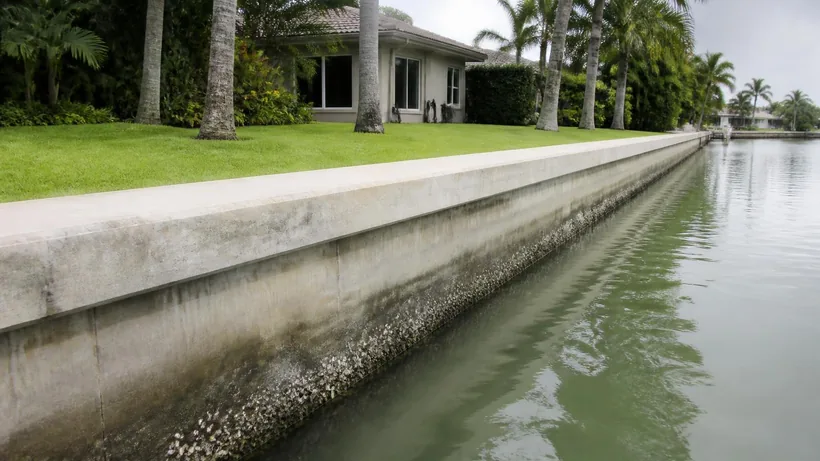
What a seawall actually is, and why that matters
Most owners think of a seawall as the concrete face they see from the dock. It is more useful to think of it as a system with four parts, because failures are almost always in one specific part and the repair depends entirely on which.
The panels are the vertical concrete members driven into the bottom. They do the retaining. They are reinforced, and the reinforcement inside them is the thing that determines their lifespan.
The cap is the horizontal concrete beam along the top. It ties the panels together, distributes load between them, and is usually what you are standing on. Cap cracking is frequently a messenger rather than the message.
The tiebacks are steel rods running from near the top of the wall back into your yard, to anchors or deadmen buried behind it. They hold the top of the wall against the enormous pressure of saturated soil pushing outward. You will never see them. You will absolutely see what happens when they stop working.
The soil is part of the structure, both behind the wall and in front of its toe. A wall depends on material in front of it for support and is loaded by material behind it. Move either and the wall's situation changes even though nothing about the concrete did.
Nearly every seawall conversation becomes clearer once you know which of those four is the problem. A leaning wall and a spalling wall are not different severities of the same issue. They are different failures with different fixes and different urgency.
Reading the symptoms
Broward walls tend to announce themselves in a small number of recognizable ways. None of these is a diagnosis, but each points somewhere specific.
A depression or sinkhole in the yard
This is the one to take seriously fastest. It usually means fill is escaping through the wall — through an open joint, a crack, or a failed panel — carried out by water moving in and out with the tide. Every cycle takes a little more. The hole in the yard is the volume that has already left.
It matters beyond the cosmetic problem because the soil leaving is soil the wall and whatever is built behind it were relying on. Pool decks, patios and foundations sitting near a wall that is losing fill are being quietly undermined.
The wall leaning toward the water
Leaning is a restraint failure. The panels are being pushed out at the top because the tiebacks are no longer holding them back — corroded through, pulled loose, or anchored in ground that has lost its grip.
The important implication: repairing the face of a leaning wall addresses nothing. The concrete is not what failed. Until the anchoring is restored or supplemented, the wall continues to move.
Spalling — concrete flaking or breaking away
Spalling happens because the steel reinforcement inside the concrete is corroding. Corroding steel expands, and expansion inside concrete breaks it apart from within. So spalling is not surface damage. It is evidence that the reinforcement has already lost section, and that the concrete cover which was protecting it has been compromised.
This is why cosmetic patching is often the wrong instinct. Covering spalled concrete without dealing with the corrosion leaves the mechanism running underneath, and it can make things worse by trapping moisture against the steel.
Cracking in the cap
Pattern matters more than presence. Fine surface crazing is frequently unremarkable. A crack running along the length of the cap, or one that has opened rather than merely appeared, often means the panels below are moving differentially — which sends you back to the tiebacks and the soil.
Gaps opening at panel joints
Vertical joints between panels that were tight and are now open are both a symptom of movement and a cause of further trouble, because an open joint is the path fill uses to leave. This is frequently the mechanism behind the yard depression.
Rust staining
Rust bleeding through the face is the corrosion telling you about itself before the concrete comes off. It is an early-warning version of spalling and a good reason to have the wall looked at while options are still cheap.
Request a callback
Send the address and what the wall is doing. We will call you back.
Talk through your site
Photographs of the wall, the cap and the yard behind it, plus the address, are enough to start a useful conversation.
What we do
Seawall Repair
Cracks, spalling, voids behind the wall, and what each one is actually telling you.
Seawall Inspection
What a real inspection looks at, above and below the waterline.
Seawall Replacement
When a wall is past repair, and what replacing it involves on a tight canal lot.
Tiebacks & Anchoring
Supplemental tiebacks, deadmen and why walls lean before they fail.
Seawall Caps
Cap cracking, cap raising and the difference between the two jobs.
Docks & Boat Lifts
The upgrade side: dock rebuilds, lifts and finishing the waterfront.
Why South Florida is hard on seawalls specifically
Reinforced concrete in warm salt water is in a slow chemical argument it eventually loses. The question is only how long the concrete can protect the steel inside it, and several things local to Broward push on that timeline.
Chloride and the reinforcement
Salt water carries chlorides, chlorides migrate through concrete, and when they reach the reinforcement they break down the passive layer that normally protects it. Once corrosion starts it is self-sustaining and expansive. The depth and quality of concrete cover over the steel is therefore the single largest factor in how long a wall lasts, and it was decided when the wall was built.
The tide works the structure twice a day
The wet-dry cycle at the waterline is more aggressive than permanent immersion. It concentrates salt, it drives water in and out of any crack, and the band around the tide line is frequently where deterioration is most advanced.
Wake, all day, forever
On a busy canal, passing boats work joints, push water into cracks and back out, and stir the bottom at the toe of the wall. It is not dramatic on any given day and it is completely relentless over years. Walls on busy stretches genuinely age faster than otherwise identical walls on quiet ones.
Groundwater and rain
The load on a seawall comes from soil behind it, and saturated soil is much heavier and pushes much harder than dry soil. A wall that copes in ordinary conditions can be asked for considerably more after prolonged heavy rain. Drainage behind a wall is not a detail.
Storms
Storm surge and the associated water level changes load a wall in both directions, and rapid drawdown after a surge can be particularly demanding. Storms rarely create a problem out of nothing; they find what was already marginal and accelerate it.
Repair, supplement, or replace
These are genuinely different projects, and owners are frequently quoted one when they need another.
Repair
Appropriate when the structure is sound and specific defects are not. Joint sealing, panel repairs, properly executed concrete restoration that removes contaminated material and treats the reinforcement rather than covering it, cap repairs where the cap itself is the problem. Sensible, comparatively economical, and genuinely extends life when the underlying system is healthy.
Supplement
Frequently the most cost-effective real answer, and the one owners have usually not heard of. Where panels are sound but restraint has failed, adding a new anchoring system — supplemental tiebacks to new anchors — restores the thing that actually failed without replacing concrete that is still doing its job. A leaning wall with good panels is often a candidate.
Replace
When the panels themselves are deteriorated past the point where restoration is sensible, or when the wall has moved so far that it cannot be brought back, or when the retained height needs to change. Replacement is the large project: demolition or abandonment of the old wall, new panels driven, new cap, new anchoring, backfill and restoration of the yard.
The decision between these is not a matter of taste. It comes from what the inspection finds, and any contractor who reaches a conclusion without looking below the waterline is guessing on your behalf.
What drives cost
No page on this site quotes a price, and there is a reason beyond caution: the variables are large enough that a number given without seeing the site would be actively misleading.
- Linear footage. The most obvious driver and the first question.
- What is actually wrong. Anchoring versus panels versus cap are different jobs.
- Retained height and panel depth. How much soil the wall holds and how far the panels must go.
- Access. Whether equipment can work from the yard, or the job has to run from a barge. On tight Broward lots this is frequently decisive and it changes both method and schedule.
- Permitting class. Repair, reconstruction and any work waterward of the existing line are treated differently.
- Mobilization. Getting equipment to a canal lot is a real cost, and it is the reason doing your wall at the same time as a neighbor is often cheaper for both.
- Restoration. What happens to the yard, the deck and the landscaping afterwards.
- Spoil and disposal. Where demolished material goes.
That is the honest frame. A contractor looks at the wall, above and below the water, looks at the access, and gives you a figure. Anything before that is a number pretending to be an answer.
Where we work
Broward's waterfront is a canal system rather than a shoreline, and conditions change from one reach to the next — depth, boat traffic, canal width, how much of the frontage has already been rebuilt, and how old the original walls are.
Fort Lauderdale
Las Olas Isles, Rio Vista, Harbor Beach and the finger canals.
Pompano Beach
The Intracoastal reach and the canals off it.
Hollywood
North Lake, Hollywood Lakes and the south Broward canals.
Lighthouse Point
Deep canals, big boats, and walls that carry real load.
Lauderdale-by-the-Sea
A narrow barrier strip with water on both sides.
Dania Beach
The Dania Cut-Off Canal and the working waterfront.
If you are buying a waterfront home
This is the highest-value paragraph on the page for anyone under contract.
A seawall is a major structure, it is expensive to replace, its condition is largely invisible, and a standard home inspection does not establish its state. Buyers routinely scrutinize a roof with great care and accept a seawall on the basis of it looking fine from the dock.
A proper inspection before closing — including the underwater portion — tells you whether you are buying a structure with decades left or a significant capital project with a short fuse. Either answer is useful. Not knowing is the expensive option.
It is also worth asking for the permit history on any seawall work that has been done, and establishing whether the wall has been repaired, supplemented or rebuilt, and when.
Living with a seawall
Between inspections there is a short list of things an owner can do that genuinely affects how long the wall lasts.
- Walk it annually, and after any significant storm. Look for new cracking, movement at joints, separation between cap and panels, and any settlement in the ground behind.
- Watch the yard, not just the wall. Depressions, sinking pavers and a pool deck that has developed a slope are all seawall symptoms.
- Keep joints sealed. It is a small maintenance item that closes the route fill uses to escape.
- Pay attention to drainage. Water that has nowhere to go ends up in the soil behind the wall, and saturated soil pushes harder.
- Photograph it. A dated set of photos each year turns "I think that crack is worse" into something you can actually judge.
- Do not ignore rust staining. It is the early version of a more expensive conversation.
None of that replaces an inspection, and none of it stops chloride reaching reinforcement. It does buy time, and on a structure this expensive, time is worth real money.
Getting proposals you can actually compare
Seawall proposals are unusually difficult to put side by side, and the reason is not that contractors are being evasive. It is that without a diagnosis, each one is pricing their own reading of the symptoms, and on this structure the range of reasonable readings is very wide. The same wall can honestly attract a proposal for joint sealing and a proposal for full replacement.
The fix is to settle the finding first. An inspection that states what failed lets you ask every contractor to price against the same conclusion, which converts a set of opinions into a set of comparable numbers.
Ask each proposal to state, in writing:
- What it believes has failed, and how that was established.
- What specifically will be done about it, including what happens to the reinforcement in any concrete work.
- What is excluded.
- What happens to the yard, the dock and the landscaping, and what restoration covers.
- What permitting is assumed, and who is responsible for obtaining it.
- How access will be achieved — from the yard or from the water.
A proposal that answers those is comparable to another proposal that answers those. One that offers a length and a number has not engaged with the question, and should be treated as a starting point rather than a quote.
Doing it with a neighbor
Mobilization is a genuine and substantial cost on a canal lot, particularly where work has to run from a barge. It is largely fixed, which means it is a much larger share of a small project than of a large one.
Where an adjacent owner is in a similar position, doing both walls under one mobilization is usually cheaper for both parties than two separate projects. It also resolves the return where the two walls meet properly, rather than leaving a junction between new work and old work that will be the first place trouble appears.
It is worth a conversation over the fence even if it delays your own project slightly, because the saving is real and the detailing at the shared return is better done once.
Seawall questions, answered properly
Who is responsible for the seawall between two properties?
Each owner is generally responsible for the wall on their own frontage, and the return where two walls meet is the junction that belongs to both in practice. It is a common place for trouble to start, and it is worth looking at during any inspection and raising with the neighbor if either of you is planning work.
How do I know if my seawall needs repair or replacement?
The honest answer is that you cannot tell from the top. A wall that looks sound from the yard can be losing material behind it, and a wall with visible cracking can be structurally fine. What decides it is the condition of the panels below the waterline, whether the tiebacks are still holding, and whether soil is escaping through joints. That is an inspection question, and it is the first money worth spending.
What does a sinkhole in my yard near the seawall mean?
Usually that soil is leaving through the wall. Water moves back and forth through a failed joint or a crack, and each cycle takes a little fill with it. The void appears in the yard because that is where the material went from. It is one of the clearer signals that a wall needs attention promptly rather than eventually, because the loss is ongoing and the wall is losing the support it depends on.
Why is my seawall leaning toward the water?
A seawall is held back at the top by tiebacks running to anchors buried in the yard. When those corrode, fail, or lose their grip, the earth pressure behind the wall pushes the top outward. Leaning is the visible symptom of a restraint problem rather than a panel problem, and it generally means the anchoring needs addressing rather than the face.
How long does a seawall last in South Florida?
Longer when it is maintained and much shorter when it is not, and the variables are real: the quality of the original construction, the cover over the reinforcement, exposure to boat wake, and whether joints have been kept sealed. Salt water and reinforced concrete are in a slow argument, and the thing that decides the timeline is usually how well the concrete protects the steel inside it.
What is spalling and is it serious?
Spalling is concrete breaking away, usually in flakes or chunks, because the reinforcing steel inside has corroded and expanded. It matters because it is a symptom rather than a blemish: by the time concrete is coming off, the steel behind it has already lost section. Patching the surface without addressing the corrosion underneath buys appearance rather than time.
Can a seawall be repaired from the water side only?
Some work can, and on a tight lot that is a real advantage because it avoids tearing up the yard. Panel repairs, joint sealing and some cap work are reachable from a barge. Anchoring problems generally are not, because the anchors are in the ground behind the wall. Which approach applies is decided by what is actually wrong.
Do I need a permit to repair my seawall in Broward?
Seawall work in Broward generally involves permitting, and what applies depends on the municipality, the scope, and whether the work is repair or reconstruction. Replacing a wall is treated differently from patching one, and work waterward of the existing line raises additional questions. It is worth establishing the permitting picture before scope is settled rather than after.
What drives the cost of seawall work?
Linear footage first. Then the condition of the existing wall and cap, whether the anchoring system has to be replaced or supplemented, how deep the panels have to go, access — whether equipment can reach from the yard or the work has to be done from a barge — the permit class, mobilization, and what happens to the spoil. Two walls of the same length on the same canal can differ substantially on access alone. A contractor gives you a figure after seeing it.
How long does seawall replacement take?
It depends on length, access and method, and the permitting that precedes it usually takes longer than the construction. Barge-based work also runs on tide and weather windows. Anyone offering a firm duration before seeing the site is guessing.
Will replacing my seawall damage my landscaping?
Land-based work generally affects a strip of yard behind the wall, because that is where the anchors go and where equipment has to sit. Good contractors minimize it and plan the route in advance, and barge-based methods reduce it further where they are feasible. It is a reasonable thing to ask about specifically before work starts.
Can I add height to my existing seawall?
Cap raising is a common request as owners think about higher water, and it is sometimes straightforward and sometimes not. The question is whether the existing wall and its anchoring can carry the additional retained height and load. Raising a cap on a wall that is already marginal transfers more load to a system that was not managing the old load.
What is a tieback and how do I know if mine have failed?
A tieback is a rod running from near the top of the wall back to an anchor buried in the yard, holding the top against the earth pressure behind it. You rarely see them. You see what happens when they fail: the wall leans, the cap cracks along its length, gaps open at panel joints, or the ground behind starts to settle.
Is a cracked seawall cap urgent?
It depends entirely on the pattern. Fine surface cracking may be cosmetic. A crack running the length of the cap, or one that has opened up, often indicates movement in the wall rather than a problem with the cap itself, and that is worth looking at promptly.
My neighbor is replacing their seawall. Does that affect mine?
It can. Adjacent walls interact at the return where they meet, and work next door can expose or affect that junction. It is also frequently the most economical moment to do your own, because mobilization is one of the real costs and a shared mobilization is cheaper than two.
Can a seawall be inspected underwater?
That is where the important part of the inspection happens. What is visible above the waterline is a fraction of the structure, and the conditions that matter most — panel deterioration, joint separation, scour at the toe, undermining — are below it.
What is scour and why does it matter?
Scour is the removal of material at the base of the wall by moving water, including propeller wash from boats. It matters because a seawall depends on the soil in front of its toe for support. Take that away and the wall loses part of what is holding it in position, regardless of how sound the panels look.
Does boat wake damage seawalls?
Persistently, yes, and it is cumulative rather than dramatic. Wake works joints, drives water in and out of cracks, and contributes to scour at the toe. On a busy canal it is one of the reasons walls in otherwise similar condition age at different rates.
Should I seal or coat my seawall?
Sealing joints and protecting sound concrete can genuinely extend service life. Coating a wall that is spalling because its reinforcement is corroding mostly hides the problem, and can trap moisture against the very steel that is causing it. Whether coating is useful depends on what is actually wrong.
What is the difference between a seawall and a bulkhead?
The terms are often used interchangeably in South Florida for a vertical retaining structure at the water. What matters more than the label is the construction: concrete panels with a cap and tiebacks, versus other systems, behave differently and fail differently.
How often should a seawall be inspected?
A walk of your own wall annually and after any major storm, looking for new cracking, movement at joints, cap separation and settlement in the yard behind it. A proper inspection including the underwater portion is worth doing periodically and certainly before buying a waterfront property.
I am buying a waterfront home. Should I get the seawall inspected?
Yes, and treat it as seriously as the roof. A seawall is a major structure whose condition is largely invisible, it is expensive to replace, and its state is not something a general home inspection establishes. This is the single highest-value inspection on a canal-front purchase.
Will my homeowners policy cover seawall failure?
Coverage for seawalls varies considerably and is frequently limited or excluded, particularly for deterioration over time as opposed to sudden damage. That is a question for whoever handles your policy rather than for a contractor, and it is worth asking before you need the answer.
What happens if I do nothing?
Seawall problems do not stabilize on their own, because the mechanisms driving them — corrosion, soil loss, water movement — continue. A wall that needs tiebacks now needs more work later, and a wall that is losing fill is undermining the yard, the pool deck or whatever else sits behind it. The cost curve is one-directional.
Can work start before the permit is issued?
No. Starting marine work without the required authorization creates an enforcement problem on top of the original structural one, and unwinding it is slower and more expensive than waiting. The permitting comes first.
Talk through your site
Send the address and photographs of the wall, the cap, and the ground behind it. If there is a depression in the yard, photograph that too — it is often the most informative picture.