Home › Services
Seawall caps: repair, replacement and raising
The cap is the part everyone sees and the part most often misread. Cracking in it is usually a message about the wall below.
What the cap is for
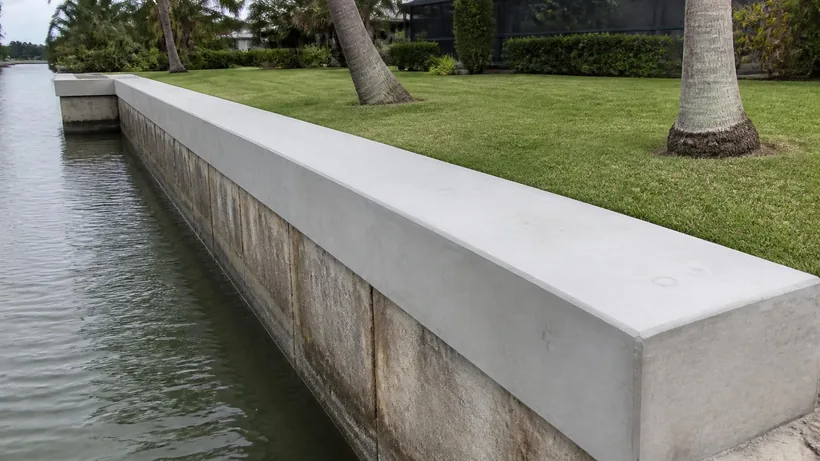
The cap is the horizontal concrete beam running along the top of the wall. It is doing more than finishing the edge.
It ties the individual panels together so they behave as one structure rather than as a row of separate elements, distributing load between them. It provides the connection point for the tiebacks. It protects the top of the panels. And it is the surface people walk on, mount cleats to, and attach docks and rails to.
Because it connects everything, it is also where differential movement shows up first. A cap that is cracking is frequently reporting on panels or anchoring rather than on itself.
Reading the cracking
Pattern is the whole diagnosis, and it separates a cosmetic issue from a structural signal.
Fine surface crazing — a network of shallow hairline cracks — is common and frequently unremarkable. It is a surface condition rather than a structural one, though it does let water in, which matters over time.
Transverse cracks, running across the cap at intervals, are worth understanding but are often related to shrinkage, joint spacing or local stress rather than to wall movement.
A longitudinal crack running along the length of the cap is the one to take seriously. It frequently indicates that the cap is being bent — that the top of the wall is moving outward while the cap is trying to hold the line.
Separation between cap and panels, or a step in the cap line where one section has moved relative to the next, indicates differential movement and belongs in an inspection rather than a patching quote.
Rust staining along the cap tells you the reinforcement inside it is corroding, which is a timeline problem rather than an immediate one — but it is the early version of spalling.
The mistake worth avoiding
Repairing a cap that is cracking because the wall is moving is the seawall equivalent of repainting a wall with a structural crack in it. The finish improves and the mechanism continues.
Before agreeing to cap work, it is reasonable to ask what is causing the cracking, and how that was established. If the answer is about the cap alone, ask whether the panels and anchoring have been assessed.
Cap repair and replacement
Where the cap itself is the problem — deteriorated concrete, corroded reinforcement, damage — it can be repaired or replaced without replacing the wall beneath.
The work follows the same logic as any marine concrete restoration: remove back to sound material, expose and treat the reinforcement properly, rebuild with a system specified for this environment. Half measures on a cap fail in the same way and for the same reasons as half measures anywhere else on the wall.
Full cap replacement is a larger operation and involves detaching whatever is connected to it — tiebacks, dock connections, rails — and reinstating those properly afterwards. Those connections are frequently where a cap replacement either succeeds or quietly stores up a problem.
Cap raising, and what it really asks of the wall
Raising a seawall cap has become a common request as owners think about higher water and about how often the yard is wet.
The concept is straightforward: add height to the top of the wall so it retains more and overtops less. The engineering is not, because raising the cap increases the retained height, and increased retained height means more soil, more load, and more demand on both the panels and the anchoring.
That is the central point. Cap raising is not a surface modification. It is a change to what the structure is being asked to do. A wall that was comfortably managing its original load may be marginal at the new one, and a wall that was already marginal will be worse.
So the real question before raising a cap is whether the existing panels and tiebacks can carry the increased demand — which brings you back, again, to an inspection of the parts you cannot see.
Where the existing system cannot carry it, raising is still often achievable, but as part of a package that includes supplemental anchoring rather than on its own.
Practical considerations when raising
- How the new work bonds to the existing cap, and whether reinforcement is continuous.
- What happens at the returns where your wall meets a neighbor at a different height.
- Whether the raised height affects drainage behind the wall, which can make the soil heavier and the problem worse.
- Whether dock connections, cleats, rails and lifts need reworking to suit the new level.
- What the permitting position is, since changing the profile of a seawall is not automatically treated as a repair.
Caps, docks and attached loads
The cap is a convenient thing to attach to, and over the years it frequently accumulates attachments nobody structurally assessed: dock framing, lift components, rails, davits.
Each of those applies load, sometimes concentrated and sometimes cyclical. A lift working a boat up and down applies a repeated load at specific points. A dock bearing on the cap transfers whatever the dock carries.
Where the cap is being asked to carry real structure, that should be a deliberate design decision rather than an accumulation. It is also worth checking during any inspection, because attachment points are a common location for cracking and for corrosion where fixings penetrate the concrete.
Maintenance that actually helps
- Keep joints in and around the cap sealed, so water is not tracking into the concrete and down into the panel joints.
- Photograph the cap annually from the same positions, so changes in crack pattern are visible rather than remembered.
- Sight along the cap once a year. A straight line that has stopped being straight is the earliest reliable sign of movement.
- Treat rust staining as information rather than staining.
- Do not power wash aggressively at deteriorating concrete; it removes material that is doing a job.
Caps and higher water
A great deal of current interest in cap raising comes from owners watching how often the yard is wet and wondering whether the wall can be asked to do more.
It is a reasonable question and it deserves a careful answer rather than an enthusiastic one. Raising a cap addresses overtopping, which is a real problem when it happens. It does not address groundwater coming up from below, which in parts of South Florida is the other half of the picture and is unaffected by how high the wall is.
So the useful first question is what kind of water is causing the problem. If the yard is wet because the canal comes over the wall, raising helps. If it is wet because the water table is high, a taller wall changes very little and the money is better spent elsewhere.
An honest contractor will ask which it is before quoting the raise.
Sequencing cap work with everything else
The cap is the connection point for the tiebacks and frequently for the dock, which makes it the piece that has to be coordinated with the rest.
If anchoring work is coming, the cap is involved, and doing cap restoration first means disturbing it again. If a dock is being rebuilt, its connections land on the cap, and it is far easier to detail those into new work than to retrofit them.
The general rule is the same as everywhere on a seawall: structure before surface, and anything requiring the same access grouped into one visit.
Cap work and the things bolted to it
Before any cap project, take an inventory of what is currently attached: cleats, rails, ladders, dock framing, lift components, lighting, hose bibs, anything that penetrates the concrete.
Each of those is a decision during the work — reinstate as is, upgrade, relocate, or leave off. Each penetration is also a corrosion path, so the fixings that go back in matter as much as the concrete around them.
It is much easier to design these into new cap work than to retrofit them afterwards, and a cap that comes back without somewhere to tie a line is a frustrating outcome that was entirely avoidable.
Seawall caps — common questions
Is my wet yard a seawall problem at all?
It depends whether water is coming over the wall or up from below. Raising a cap addresses overtopping and does essentially nothing about a high water table, so establishing which one you have is the first question rather than the second.
Can the cap be replaced without replacing the panels?
Yes, where the cap is what has deteriorated. It is a larger operation than cap repair because tieback and dock connections have to be detached and properly reinstated, and those connections are where it either succeeds or stores up a problem.
How much height can be added?
That is set by what the existing panels and anchoring can carry, not by what you would like. On a marginal wall, raising generally needs to come as a package with supplemental anchoring rather than on its own.
Is a cracked seawall cap serious?
It depends on the pattern. Fine surface crazing is often unremarkable. A crack running along the length of the cap, separation from the panels, or a step in the cap line usually indicates the wall below is moving, and that belongs in an inspection.
Can I just repair the cap?
If the cap itself is what has deteriorated, yes, and it can be done without replacing the wall. If the cap is cracking because the wall is moving, repairing it improves the finish and changes nothing about the cause.
What is cap raising?
Adding height to the top of the wall so it retains more water and overtops less. It is popular as owners think about higher water, and it is a structural change rather than a cosmetic one because it increases the load the wall carries.
Can any seawall have its cap raised?
No. Raising increases retained height, which increases demand on the panels and the anchoring. Whether your wall can carry that is the question to answer first, and on a marginal wall raising usually needs to come with supplemental anchoring.
What happens where my wall meets my neighbor’s at a different height?
The return needs deliberate detailing. It is a common weak point generally, and a height difference makes it more so. It is worth raising with the contractor rather than leaving to be resolved on site.
Can I attach a dock or lift to my cap?
Frequently, but it should be assessed rather than assumed. Attachments apply load, lifts apply repeated load at specific points, and fixings that penetrate the concrete are entry points for corrosion.
Does cap work need a permit?
Generally, and changing the profile of a wall by raising it is not automatically treated the same as repairing in kind. Establish the position before settling scope.
What is the cheapest useful cap maintenance?
Keeping joints sealed and photographing it annually from fixed positions. The first keeps water out of the concrete and the joints below; the second turns "I think that is worse" into something you can actually judge.
Talk through your site
Start with the address and photographs of the wall, the cap and the yard behind it. An inspection answers the rest.
Related work
Seawall Repair
Cracks, spalling, voids behind the wall, and what each one is actually telling you.
Seawall Inspection
What a real inspection looks at, above and below the waterline.
Seawall Replacement
When a wall is past repair, and what replacing it involves on a tight canal lot.
Tiebacks & Anchoring
Supplemental tiebacks, deadmen and why walls lean before they fail.
Docks & Boat Lifts
The upgrade side: dock rebuilds, lifts and finishing the waterfront.
Where we do it
Fort Lauderdale
Las Olas Isles, Rio Vista, Harbor Beach and the finger canals.
Pompano Beach
The Intracoastal reach and the canals off it.
Hollywood
North Lake, Hollywood Lakes and the south Broward canals.
Lighthouse Point
Deep canals, big boats, and walls that carry real load.
Lauderdale-by-the-Sea
A narrow barrier strip with water on both sides.
Dania Beach
The Dania Cut-Off Canal and the working waterfront.