Home › Services
Docks, boat lifts and finishing the waterfront
The upgrade side of waterfront work — and the part where sequencing with the seawall saves real money.
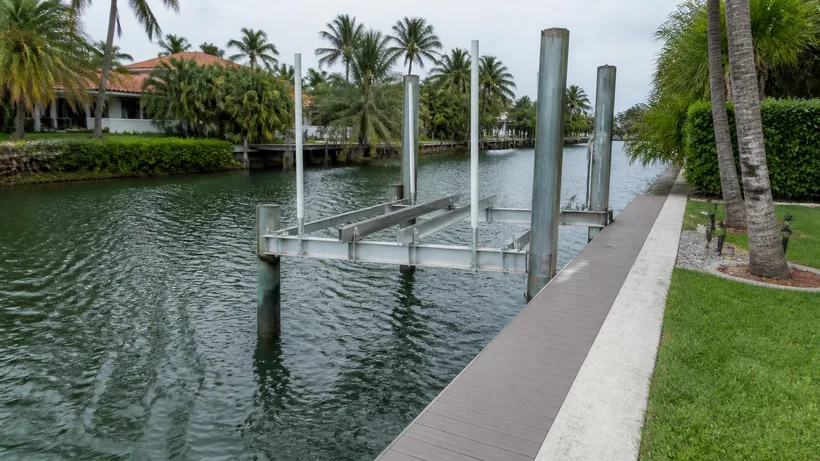
Do the seawall first
This is the single most useful thing on this page, so it goes at the top.
A new dock and a new lift are frequently attached to, or bearing on, the seawall. If the seawall needs work in the next few years, building a dock on top of it means removing and reinstating that dock when the wall is done.
Owners do this more often than you would expect, usually because the dock is the exciting project and the seawall is the boring one. The result is paying twice for the same dock.
The right order is: inspect the wall, deal with whatever it needs, then build the dock and fit the lift. If the wall turns out to be sound, nothing is lost by having checked. If it is not, a great deal has been saved.
Boat lifts and what they ask of the structure
A lift concentrates a large load, applied and removed repeatedly, at specific points. Whatever carries it — piles, the seawall, the cap, the dock framing — has to be designed for that.
Where a lift bears on a seawall cap, that is a structural decision rather than a mounting convenience. Cyclical loading at a point on a cap that was designed to tie panels together is worth assessing rather than assuming, particularly on an older wall.
Where a lift runs on its own piles, those piles are their own structure, and their depth and capacity are the question.
Sizing a lift honestly
The commonest specification error is sizing to the manufacturer dry weight of the boat.
The load that matters is the boat as it actually floats: fuel and water aboard, batteries, engines, hardware, gear and whatever has accumulated over a few seasons. That figure is meaningfully higher than the brochure number, and a lift sized to the optimistic version is being run near its rating every time it is used.
Beam and hull form matter as much as weight, because the bunks or slings have to support the hull where the hull wants support. A lift that carries the weight and cradles the boat badly is still the wrong lift.
And if a bigger boat is plausible within the life of the lift, that is the moment to think about it, because upgrading a lift later frequently means changing the structure that carries it.
Living on a Broward canal
The daily realities here shape what a good dock looks like.
Wake is constant on busy canals and it works everything: lines, fenders, lift cables, hardware, and the boat itself. Fendering that assumes contact rather than hoping to avoid it is the practical approach.
Tidal range is modest compared with some coasts, which makes fixed docks workable where elsewhere a floating arrangement would be necessary. That simplifies things considerably.
Salt air does what salt air does. Hardware is the consumable, and mixing metals accelerates the process. Specifying fixings properly at build time is invisible work that pays off years later.
Sun is hard on deck surfaces and on anything with a fabric or plastic component. Composite decking is popular and genuinely low maintenance, and it also gets hot underfoot in a Broward summer, which matters on a surface people use barefoot.
Dock construction on a canal
Most Broward dock work is either a fixed dock along the seawall or a platform structure on its own piles, sometimes with a lift integrated.
Framing and decking choices follow the same logic as anywhere in salt water: treated or composite, fastenings specified for the environment, and connections detailed so that water is not held against metal.
Utilities — power for a lift, water for washdown, lighting — are much cheaper to install during construction than to retrofit under a finished deck. Anything electrical near salt water wants specifying properly, and it is not the place to economize.
Cleats, ladders, rails and fendering are the items owners interact with daily and the ones most often under-specified. They are also comparatively inexpensive, which makes them a poor place to save.
Permitting and the neighbors
Dock and lift work in Broward generally involves permitting, and what applies depends on the municipality and on how far the structure projects into the waterway.
Canal width is the practical constraint that surprises people. On a narrow canal, how far a dock or a moored boat extends affects navigation for everyone, and that is reflected in what gets approved.
Structures also interact with the neighboring properties at the returns, and a dock built hard against a property line is worth discussing with the neighbor before rather than after.
Maintenance rhythm
- Inspect lift cables regularly for broken strands, corrosion and flat spots, and replace on condition rather than on a calendar.
- Keep motor and switchgear enclosures intact and connections dry.
- Check bunks and carpet for wear that could mark a hull.
- Rinse the lift when you rinse the boat.
- Walk the dock annually looking for fastenings standing proud and movement at connections.
- Check where the dock or lift bears on the seawall cap, which is a concentrated load in a corrosive location.
Storm posture on a canal
Broward waterfront owners generally have a hurricane plan for the house and a vaguer one for the boat and the dock, and the vaguer one is worth firming up before it is needed.
A lift is not a storm mooring. A boat left on a lift in serious weather is exposed to wind loading at height, and surge can lift a hull off its bunks entirely. The structure carrying it was designed for a static load in ordinary conditions.
The useful version of a plan names where the boat goes, how much notice moving it needs, and who moves it if you are not there. Storage fills up quickly when a storm is forecast, which is the practical argument for deciding early rather than at the same moment as everyone else.
On the dock itself: loose items come off, fendering is checked, and anything that can float away is secured or removed. After the storm, look at the seawall before using the dock, because surge loads the wall in both directions and the damage that matters is frequently below the waterline.
What gets used and what does not
The features owners value after a year are rarely the ones that dominated the planning conversation.
What gets used constantly: a ladder, good cleats in the right places, a hose bib, lighting that works, somewhere to sit, and enough deck to move around a boat while carrying something.
What gets used less than expected: elaborate built-in furniture, oversized platforms, and anything that requires maintenance to stay presentable.
On a canal lot where space and permitted projection are both limited, spending the available structure on the things used daily is generally a better outcome than spending it on the things that photograph well.
Sizing the dock to the lot, not the catalog
Canal lots have limited frontage and limited permitted projection, which means dock design here is an exercise in allocation rather than expansion.
The useful question is what the structure has to do: board a boat safely, land things on, tie up, get in and out of the water, and give people somewhere to be. Each of those has a minimum that works and a generous version that consumes frontage.
Owners who allocate deliberately end up with a dock that does everything they need. Owners who scale up every element in proportion end up with a structure that projects further than it needed to and still has an awkward boarding arrangement.
Docks, boat lifts and finishing the waterfront — common questions
Is composite decking worth it in Broward?
It avoids splinters and refinishing, which matters on a surface people walk barefoot, and it is genuinely low maintenance. It also gets properly hot under a South Florida summer sun, which is the trade-off to weigh rather than a reason to avoid it.
What should I do with the boat before a storm?
Move it. A lift is not a storm mooring — wind loading at height and surge lifting a hull off its bunks are both real, and the structure was designed for a static load in ordinary conditions. Decide where it goes early, because storage fills fast.
What do owners actually use most?
A ladder, cleats in the right places, a hose bib, lighting that works, somewhere to sit, and enough room to move around the boat carrying something. Rarely the elaborate built-ins that dominated the planning conversation.
Should I check the seawall after a storm before using the dock?
Yes. Surge loads a wall in both directions and the damage that matters is frequently below the waterline, so a structure that looks intact from above can have moved.
Can I extend my dock further into the canal?
How far a structure projects is a permitting question and, on a narrow canal, a navigation question that affects everyone on it. It is not simply a matter of your own frontage.
Should I build the dock before or after seawall work?
After, essentially always. A dock attached to or bearing on a wall that later needs replacing has to be removed and reinstated, which means paying for it twice. Inspect the wall first even if you expect it to be fine.
Can a boat lift mount on my seawall?
Sometimes, but it is a structural question rather than a mounting convenience. A lift applies a large repeated load at specific points, and an older cap designed to tie panels together may not be the right thing to carry it.
What lift capacity do I need?
Size to the boat as it floats loaded — fuel, water, batteries, engines, gear — not to the dry weight in the brochure. And if a larger boat is plausible later, factor that in now, because upgrading a lift often means changing the structure under it.
Do I need a floating dock on a Broward canal?
Usually not. The tidal range here is modest enough that fixed docks work well, which simplifies the structure considerably compared with coasts that swing further.
What maintenance does a lift need?
Cables inspected and replaced on condition, enclosures and connections kept dry, bunks watched for wear, and the whole thing rinsed when the boat is rinsed. Cable failure under load is the consequence worth avoiding and the one most reliably caught by looking.
Does dock work need a permit?
Generally yes, and how far the structure projects into the waterway matters, particularly on a narrow canal where it affects navigation for everyone.
What is the most under-specified part of a dock?
The parts owners touch daily — cleats, ladders, fendering and rails. They are comparatively inexpensive and they determine how much the dock actually gets used.
Should utilities go in during the build?
Yes. Power, water and lighting are far cheaper installed during construction than retrofitted under finished decking, and anything electrical near salt water needs specifying properly for the environment.
Talk through your site
Start with the address and photographs of the wall, the cap and the yard behind it. An inspection answers the rest.
Related work
Seawall Repair
Cracks, spalling, voids behind the wall, and what each one is actually telling you.
Seawall Inspection
What a real inspection looks at, above and below the waterline.
Seawall Replacement
When a wall is past repair, and what replacing it involves on a tight canal lot.
Tiebacks & Anchoring
Supplemental tiebacks, deadmen and why walls lean before they fail.
Seawall Caps
Cap cracking, cap raising and the difference between the two jobs.
Where we do it
Fort Lauderdale
Las Olas Isles, Rio Vista, Harbor Beach and the finger canals.
Pompano Beach
The Intracoastal reach and the canals off it.
Hollywood
North Lake, Hollywood Lakes and the south Broward canals.
Lighthouse Point
Deep canals, big boats, and walls that carry real load.
Lauderdale-by-the-Sea
A narrow barrier strip with water on both sides.
Dania Beach
The Dania Cut-Off Canal and the working waterfront.