Home › Services
Seawall inspection, above and below the waterline
The cheapest money anyone spends on a seawall is the money spent finding out what is wrong with it.
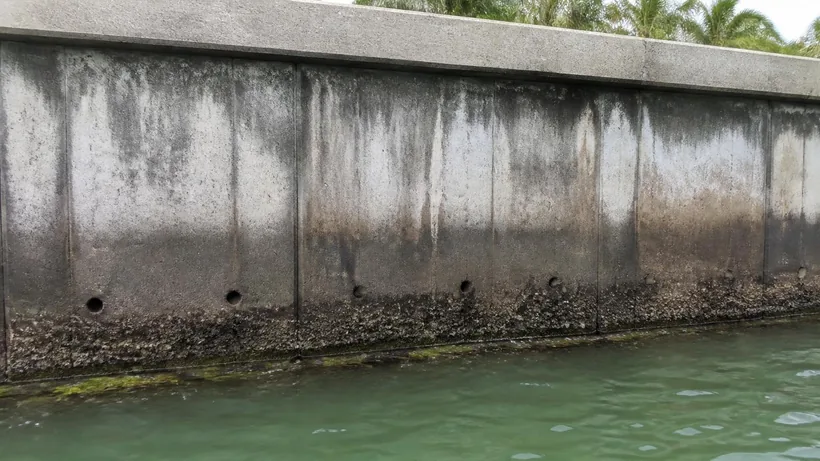
Why the visible part tells you least
Stand on a seawall cap and you can see perhaps a third of the structure, and not the important third.
The panels continue below the water to a depth you cannot see. The toe — where the wall meets the bottom and where support comes from — is underwater by definition. The tiebacks are buried in the yard. The soil behind the wall is invisible until it is not there.
A seawall can therefore look completely unremarkable from the dock while being in serious trouble, and the reverse is also true: a wall with alarming-looking surface cracking can be structurally sound. Judging by appearance from above is guessing with confidence.
What an inspection should actually cover
- The panels below the waterline: deterioration, section loss, holes, exposed or corroded reinforcement.
- Panel joints: whether they are open, and whether material is moving through them.
- The toe: scour, undermining, and whether the bottom in front of the wall has been removed by current or propeller wash.
- Alignment: whether the wall is plumb, and whether any section has moved relative to its neighbors.
- The cap: cracking pattern, separation from panels, differential movement along its length.
- Evidence of soil loss behind the wall: depressions, settlement, voids, sinking hardscape.
- Tieback condition where it can be assessed, and the behavior of the wall that implies it.
- Returns and corners, where adjacent walls meet, which are frequently where problems start.
- Any dock, lift or structure attached to or bearing on the wall.
The underwater portion is the point
If an inspection does not include getting below the waterline, it has not assessed the structure. It has assessed the visible fraction.
That is not a criticism of visual surveys as a first pass — a walk of the cap and the yard can identify plenty worth following up. But a report that reaches conclusions about remaining life without anyone having looked at the panels or the toe should be read as a preliminary opinion rather than an assessment.
Reading the yard as part of the wall
A good inspection spends time behind the wall as well as in front of it, because the ground is part of the system.
Depressions and soft spots indicate fill has left. Pavers that have started to tilt, a pool deck with a slope that was not there, a fence line that has gone out of true — these are seawall symptoms that show up on land.
Drainage matters too. Water with nowhere to go saturates the soil behind the wall, and saturated soil pushes considerably harder than dry soil. A drainage problem is a loading problem.
Vegetation is worth noting. Large root systems close to a wall both apply load and open paths for water.
Buying a waterfront property
This is the highest-value inspection on a canal-front purchase and it is routinely skipped.
A seawall is a major structure. It is expensive to replace. Its condition is largely invisible. And a standard home inspection does not establish its state — general inspectors are not diving the wall, and most reports treat it briefly if at all.
Buyers scrutinize roofs carefully and accept seawalls on the basis of a glance from the dock. The asymmetry is hard to justify, because the replacement cost of a long wall is not a small number and the timing is not within your control once you own it.
What to ask for alongside the inspection: the permit history for any seawall work on the property, when it was last repaired or rebuilt, and whether any of the neighboring walls have been replaced recently — because a wall that is the last original one on a rebuilt canal is telling you something.
Reading a report honestly
A useful report distinguishes between what was observed, what was inferred, and what could not be assessed. That third category matters: conditions that prevented part of the inspection should be stated, not quietly omitted.
Be wary of a report that reads as a sales document for a specific scope of work. Be equally wary of one that pronounces everything fine without describing what was examined.
And expect a report to tell you about rate as well as state. A wall with moderate deterioration that has been stable for a decade is in a different position from one that has visibly moved since the last set of photos.
How often, and when
An owner walk of the wall, cap and yard is worth doing annually and after any significant storm. It costs nothing and it catches the things that are cheap to fix early.
A proper inspection including the underwater portion is worth doing periodically, and specifically at these moments: before buying, after a major storm, when anything visible has changed, before committing to a large repair, and before adding load to the wall — a new dock, a lift, a heavier structure behind it.
Photographing the wall annually from the same positions is one of the most useful habits available to an owner, because it converts an argument about whether something is worse into a comparison.
What happens after
- A clear statement of what failed, or that nothing has.
- A distinction between what needs attention now, what should be monitored, and what is cosmetic.
- Enough information to get comparable proposals from more than one contractor.
- A baseline you can measure against next time.
That last item is undervalued. The first inspection is worth a great deal less than the second one, because the second tells you about direction and speed rather than only position.
What an inspection costs you in certainty, and what it buys
Owners sometimes resist inspection on the grounds that they already know the wall needs work, and the money would be better spent on the work itself.
That reasoning fails in a specific way. Without a diagnosis, the work you buy is the work the first contractor proposed, and on seawalls the range of reasonable-sounding proposals for the same wall is very wide — from joint sealing to full replacement. The inspection is what tells you which end of that range you are actually in.
It is also what lets you get comparable proposals. A contractor pricing against a known finding is quoting the same job as the next contractor. A contractor pricing against their own walk-past is quoting their own interpretation.
On a structure where the difference between the right answer and a plausible wrong answer is substantial, the diagnosis is the cheapest part of the project.
The neighbors are data
One underused source of information is the canal itself.
If most of the walls on your stretch were built at the same time as a development, they are aging on a similar timeline in similar conditions. Walls that have been replaced recently, and how many, tells you something about where that timeline has got to.
Being the last original wall on a rebuilt canal is worth noticing. It does not mean yours is failing, but it does mean the population it belongs to has been reaching the end of its service life, and that is a reason to look rather than to assume.
Documentation is part of the deliverable
Ask for photographs, including from below the waterline, and ask that they be located — which panel, which end of the wall, how far along. A photograph of deterioration that cannot be placed is much less useful a year later when you are trying to judge whether it has moved.
Ask for measurements rather than adjectives where measurement is possible: how far out of plumb, over what length, how wide the joint openings are. Adjectives are not comparable between inspections and numbers are.
And keep the file. On a structure this expensive with a failure mode this slow, the record is what converts a series of opinions into an understanding of rate.
Seawall inspection, above and below the waterline — common questions
Should I inspect before or after hurricane season?
After a significant storm is always worth it, because surge loads a wall in both directions and the damage that matters is often below the waterline. A pre-season baseline makes the post-storm comparison far more useful.
How long does an inspection take?
Less time than most owners expect for the site work, and the value is in the report rather than the duration. What matters is whether the underwater portion was actually assessed and whether the findings distinguish observation from inference.
Will the inspector also quote the work?
Sometimes, and that is worth being aware of rather than alarmed by. An assessment from someone who will also bid the repair is still useful; it is simply worth getting the scope priced by more than one contractor once the finding is established.
What should I do with the report afterwards?
Keep it with dated photographs. Its value roughly doubles at the next inspection, because a second data point tells you about direction and rate rather than only position.
Does a home inspection cover the seawall?
Generally not in any meaningful way. A standard home inspection does not include diving the wall, and most reports treat the seawall briefly or note it as outside scope. On a canal-front purchase it needs its own assessment.
Why does the inspection need to go underwater?
Because that is where the structure mostly is. Panel deterioration, joint separation, exposed reinforcement and scour at the toe are all below the waterline, and all of them bear directly on how long the wall has left.
How often should I have my seawall inspected?
Walk it yourself annually and after storms. Get a proper inspection periodically, and specifically before buying, after major weather, before a large repair, and before adding load such as a new dock or lift.
What if the report says the wall is fine?
That is genuinely useful, and it is worth keeping with dated photographs as a baseline. The value of the next inspection is much higher when there is something to compare against.
Should I get an inspection before making an offer or after?
Early enough that the result can inform the transaction. Discovering a significant capital project after closing is the outcome the inspection exists to prevent.
Can I inspect my own seawall?
You can do the useful first pass: walk the cap, look for new cracking and joint movement, check the yard for depressions and settlement, and photograph it. What you cannot do from the yard is assess the panels, the toe or the anchoring.
Does a leaning wall always mean major work?
It means the restraint is not doing its job, which is significant. Whether the answer is supplemental anchoring or replacement depends on the condition of the panels, and that is exactly what an inspection establishes.
What if part of the wall could not be inspected?
That should be stated in the report rather than omitted. A limitation you know about is manageable; one that is quietly left out of the conclusions is not.
Talk through your site
Start with the address and photographs of the wall, the cap and the yard behind it. An inspection answers the rest.
Related work
Seawall Repair
Cracks, spalling, voids behind the wall, and what each one is actually telling you.
Seawall Replacement
When a wall is past repair, and what replacing it involves on a tight canal lot.
Tiebacks & Anchoring
Supplemental tiebacks, deadmen and why walls lean before they fail.
Seawall Caps
Cap cracking, cap raising and the difference between the two jobs.
Docks & Boat Lifts
The upgrade side: dock rebuilds, lifts and finishing the waterfront.
Where we do it
Fort Lauderdale
Las Olas Isles, Rio Vista, Harbor Beach and the finger canals.
Pompano Beach
The Intracoastal reach and the canals off it.
Hollywood
North Lake, Hollywood Lakes and the south Broward canals.
Lighthouse Point
Deep canals, big boats, and walls that carry real load.
Lauderdale-by-the-Sea
A narrow barrier strip with water on both sides.
Dania Beach
The Dania Cut-Off Canal and the working waterfront.