Home › Services
Seawall repair across Broward County
Most seawall repair money is either very well spent or almost entirely wasted, and the difference is whether anyone established what actually failed.
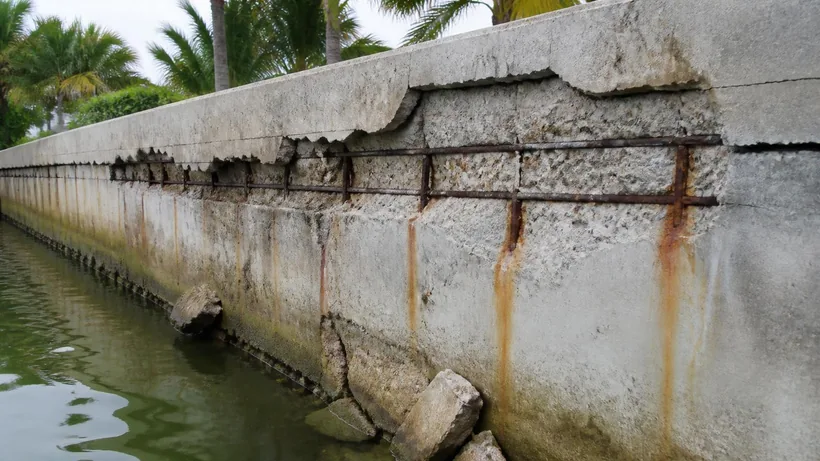
Start by naming the failure
A seawall has four working parts — the panels, the cap, the tiebacks, and the soil both behind and in front of it. Repairs that work are repairs aimed at whichever of those has gone wrong.
This sounds obvious and it is routinely skipped. Owners see spalled concrete and ask for concrete work. They see a leaning wall and ask for the face to be rebuilt. In both cases the visible material may not be the problem, and money spent on it does not change the outcome.
The single most useful thing a homeowner can do is refuse to authorize a repair until somebody has said, in plain words, which part failed and why.
Concrete restoration done properly
When panels or cap are spalling, the cause is corrosion of the reinforcing steel inside. Corroding steel expands, and that expansion breaks concrete apart from within. The flakes on the ground are a late symptom.
Proper restoration therefore has a sequence. Remove concrete back to sound material — which usually means removing more than the visibly damaged area, because chloride contamination extends beyond it. Expose the reinforcement fully around its circumference rather than just on the face. Clean it back to bright metal. Treat or replace steel that has lost significant section. Then rebuild with a repair mortar specified for marine exposure and keyed properly into the parent concrete.
Skip any of those steps and you get a repair that looks correct and fails at the edges within a few years, frequently faster than the original concrete did, because a patch over contaminated material creates a new corrosion cell right at its boundary.
Why cosmetic patching is worse than nothing
Covering spalled concrete without addressing the steel does three unhelpful things. It hides the progression, so nobody can see how fast it is moving. It can trap moisture against the reinforcement, which accelerates the corrosion it was meant to disguise. And it consumes budget that would have been better spent on a diagnosis.
If a proposal for a spalling wall does not mention what happens to the reinforcement, that is the question to ask before agreeing to anything.
Joint sealing and the soil-loss problem
Vertical joints between panels are the most common route for fill to leave a property, and soil loss is the failure that quietly damages everything built behind the wall.
The mechanism is simple. Water moves in and out with the tide. A joint that has opened lets water pass, and passing water carries fine material with it. Each cycle removes a little. Over months and years that becomes the depression in the lawn, the sinking paver, the pool deck with a new slope.
Sealing joints is comparatively inexpensive and genuinely effective when the joints are the problem and the panels are otherwise sound. It is also the repair most often deferred, because an open joint does not look alarming and a sinkhole does.
Where soil has already been lost, sealing alone leaves a void behind the wall. Filling that void is a separate operation and it needs doing, because a wall with a cavity behind it is not being supported the way it was designed to be.
Repairs that address the anchoring
If the wall is leaning, the panels are not what failed. The restraint did.
Supplemental tiebacks are frequently the right answer and are covered in detail on their own page. The relevant point here is that this is a repair rather than a replacement: it restores the function that was lost while keeping panels that are still doing their job.
Owners quoted a full replacement for a leaning wall with sound panels are entitled to ask whether supplemental anchoring was considered, and why it was ruled out if it was.
Working from the water
Broward lots are frequently tight, and the strip of yard behind a seawall is often the most valuable and least disposable part of the property — a pool deck, mature landscaping, a patio.
A meaningful amount of repair work can be done from a barge rather than from the yard. Panel repairs, joint sealing, concrete restoration on the water face and some cap work are all reachable that way, and it leaves the yard untouched.
What generally cannot be done from the water is anything involving the anchors, because the anchors are in the ground behind the wall. That is the honest limit of barge-based repair.
Barge work also runs on its own constraints: tide, weather, canal traffic and the ability to get a barge to the site in the first place. It is not automatically faster. It is frequently much less disruptive.
What a repair cannot fix
There is a threshold past which repairing stops making financial sense, and it is worth naming.
Panels that have deteriorated through their section, rather than at the surface. Walls that have moved far enough that they cannot be brought back into position. Structures where the reinforcement is compromised over most of the length rather than in patches. Situations where the retained height needs to increase beyond what the existing wall can carry.
In those cases repair money is a deposit on a replacement you will still need. A contractor who tells you that is doing you a favor.
Permitting for repairs
Repair work in Broward generally involves permitting, and what applies depends on the municipality, the scope and whether the work is genuinely repair or amounts to reconstruction.
The line matters because repairing in kind and rebuilding are treated differently, and a project that starts as a patch and grows can find itself needing authorization it did not originally require. Anything waterward of the existing wall line raises further questions.
The practical advice is to establish the permitting picture while the scope is still being decided rather than after work has started. None of this is legal advice and the permitting authorities are the authority on their own requirements.
Sequencing when several things are wrong
- Diagnose properly first, including below the waterline. Everything else depends on this.
- Deal with anything that is actively losing material — open joints, failed panels — because the loss is cumulative and ongoing.
- Fill voids behind the wall once the route out has been closed.
- Restore the anchoring if restraint has been lost.
- Then do concrete restoration on panels and cap.
- Restore the yard and the surface last, once nothing else needs access through it.
Doing it in a different order generally means paying for the same access twice, and on a canal lot access is a substantial share of the cost.
Getting comparable proposals
Seawall proposals are unusually hard to compare, because two contractors can price genuinely different scopes for the same wall and both be reasonable.
The way to make them comparable is to fix the diagnosis first. If you have an inspection that says what failed, you can ask each contractor to price against that finding rather than against their own reading of the symptoms. Without it, you are comparing opinions about the problem as much as prices for the solution.
Ask each proposal to state: what it believes has failed, what specifically will be done about it, what is excluded, what happens to the yard, and what the permitting assumption is. Proposals that answer those are comparable. Proposals that offer a length and a number are not.
Be suspicious of a quote that arrives without anyone having looked below the waterline, and of any proposal where the scope is described only in terms of what will be applied to the surface.
What a repair does not buy you
A repair restores function. It does not reset the clock on the rest of the wall.
Chloride contamination of concrete is cumulative and it continues in the areas that were not repaired. A wall with three patched sections and forty feet of original concrete is a wall with forty feet of original concrete, aging as it was.
That is not an argument against repairing. It is an argument for understanding what you have bought: time, on a specific defect, on a structure that continues to age. Knowing that makes the next decision easier rather than more alarming.
Seawall repair across Broward County — common questions
Will a repair stop the sinkhole in my yard coming back?
Only if the route the fill was using is actually closed and the void behind the wall is filled. Sealing the joint without filling the void leaves a cavity the wall is not designed to have behind it; filling the void without sealing the joint means it empties again.
Can I do part of the wall now and the rest later?
Sometimes sensibly, particularly where one section is actively losing material and the rest is stable. The caution is mobilization, which is a real cost on a canal lot and gets paid twice if the work is split without a reason.
Does repairing my wall affect my neighbor’s?
At the return where the two walls meet, it can. That junction is a common weak point and it is worth detailing deliberately rather than leaving to be resolved on site.
Can a seawall be repaired or does it always need replacing?
Plenty of walls are repairable, and the distinction is what the panels are doing. Sound panels with failed restraint, open joints or surface deterioration are repair candidates. Panels deteriorated through their section, or a wall that has moved beyond recovery, are not.
How do I know if a repair proposal is any good?
It should say which of the four parts failed and why, and for concrete work it should describe what happens to the reinforcement. A proposal that describes only what will be applied to the surface has not engaged with the cause.
Is patching spalled concrete worth doing?
Only if it is done properly: concrete removed back to sound material, reinforcement exposed all round, cleaned and treated, then rebuilt with a marine-grade repair system. A cosmetic patch over contaminated concrete typically fails at its own edges and hides the progression meanwhile.
What causes the sinkhole in my yard?
Fill escaping through the wall, almost always. Water moves in and out with the tide and carries material with it through an open joint or a failed panel. The hole is the volume that has already gone, and it will keep growing until the route is closed.
Can repairs be done without digging up my yard?
A good deal of repair work can be done from a barge — panel repairs, joint sealing, water-face concrete restoration, some cap work. Anything involving the tiebacks generally cannot, because the anchors are behind the wall.
Do I need a permit for seawall repair in Broward?
Generally yes, and what applies depends on the municipality and on whether the work is repair or reconstruction. Establish that while scope is still being decided, because a project that grows can cross into a different category.
How urgent is a repair?
Anything that is losing soil is urgent in the sense that the loss continues and compounds. Surface deterioration is usually less time-critical but does not improve on its own. A leaning wall is moving, and movement rarely stops by itself.
Will a repair extend the life of the wall?
A repair aimed at the actual failure can add genuine years. A repair aimed at a symptom generally adds appearance. That is the whole reason the diagnosis matters more than the workmanship.
Talk through your site
Start with the address and photographs of the wall, the cap and the yard behind it. An inspection answers the rest.
Related work
Seawall Inspection
What a real inspection looks at, above and below the waterline.
Seawall Replacement
When a wall is past repair, and what replacing it involves on a tight canal lot.
Tiebacks & Anchoring
Supplemental tiebacks, deadmen and why walls lean before they fail.
Seawall Caps
Cap cracking, cap raising and the difference between the two jobs.
Docks & Boat Lifts
The upgrade side: dock rebuilds, lifts and finishing the waterfront.
Where we do it
Fort Lauderdale
Las Olas Isles, Rio Vista, Harbor Beach and the finger canals.
Pompano Beach
The Intracoastal reach and the canals off it.
Hollywood
North Lake, Hollywood Lakes and the south Broward canals.
Lighthouse Point
Deep canals, big boats, and walls that carry real load.
Lauderdale-by-the-Sea
A narrow barrier strip with water on both sides.
Dania Beach
The Dania Cut-Off Canal and the working waterfront.